The Future of Ecommerce: Physical to Agentic Commerce
What comes after e-commerce? The story of shopping is a series of shifts, each one solving the friction of the era before it, and the next chapter is already taking shape around AI agents. This guide traces four eras, physical retail, e-commerce, quick-commerce and agentic commerce, with the data behind each and what it means for food. The future of ecommerce is less about a single technology and more about who does the shopping, so we end with what your team should do to position for it now.
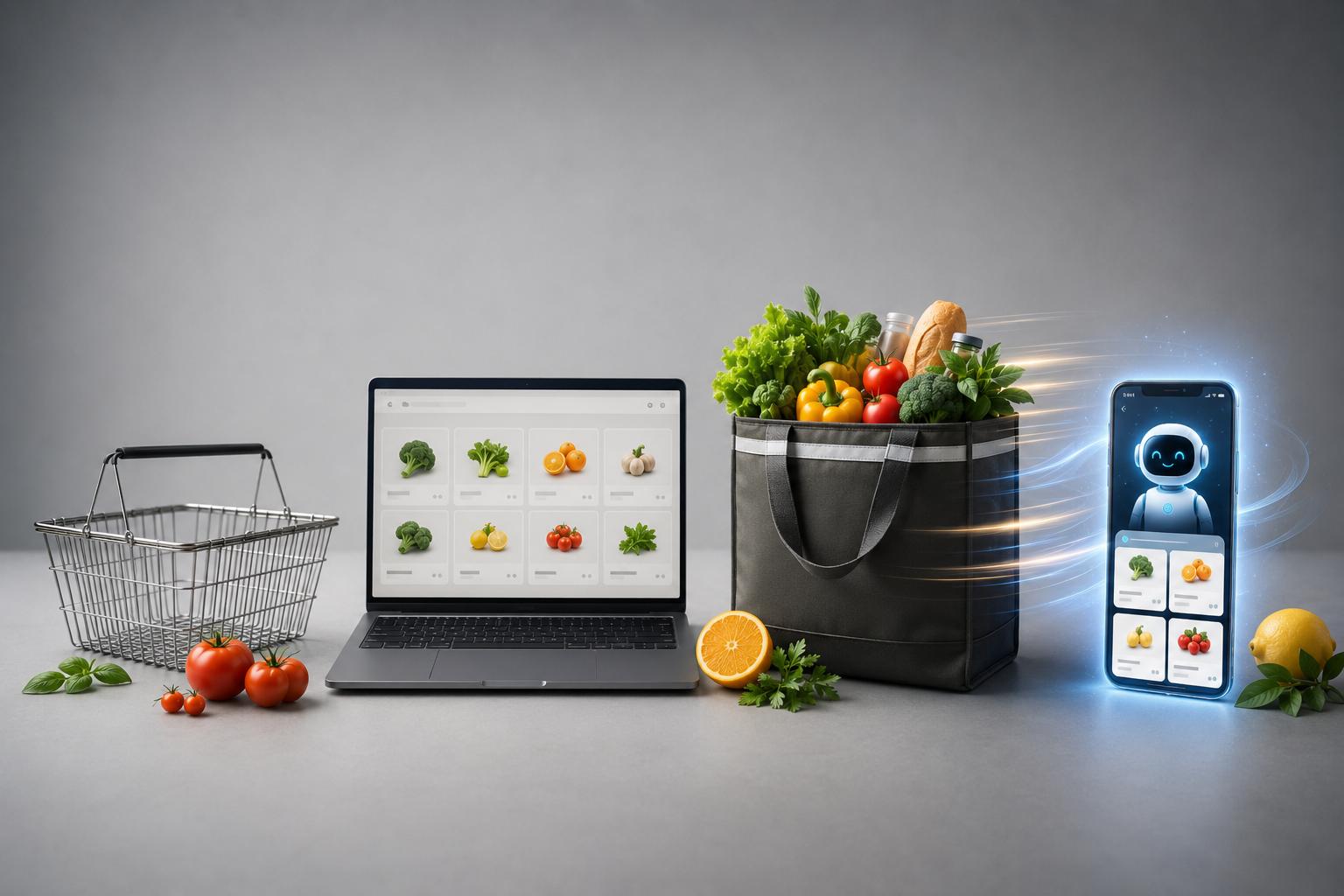
Physical retail and its limits
Physical retail solved the most basic problem in commerce: proximity. For most of history, shopping meant going to where goods were, and the store's job was to be close, well-stocked and convenient enough to visit. It built trust through tangibility, you could see, touch and carry home what you bought.
Its limits, though, are structural. Shelf space caps selection, opening hours cap access, and location caps reach. A shopper can only choose from what one store near them happens to carry, when it happens to be open. Those constraints created the opening that the next era would exploit, trading physical proximity for near-limitless choice delivered to the door.
E-commerce: selection and convenience at scale
E-commerce solved selection and convenience at scale. By moving the shelf online, retailers offered ranges no physical store could match, available at any hour from anywhere, with reviews and search to help shoppers navigate the abundance. Convenience became the headline benefit, and the storefront moved from the high street to the screen.
Yet online shopping introduced its own friction: waiting. Even with fast delivery, there is a gap between wanting something and having it, and browsing large catalogues takes real time and effort. For everyday essentials and food in particular, that delay and that effort became the pain point the following era set out to remove, one parcel and one cart at a time.
Quick-commerce: immediacy and consolidation
Quick-commerce solved immediacy, promising groceries and essentials in minutes via local dark stores. In Europe it became a sizeable market: one databook put it at roughly $36.6 billion in 2025, up 8.1% year on year, while other estimates placed it nearer $55 billion in 2025 with high-single-digit growth towards about $115 billion by 2034. Germany grew around 8.6% and France around 8.5%.
The reality, though, has been a shift from rapid expansion to consolidation. The economics of instant delivery proved hard, prompting retreats such as Getir's 2024 pull-back from several markets, alongside dark-store restrictions in cities like Amsterdam and Barcelona. Immediacy was real, but it did not, on its own, fix the effort of deciding what to buy in the first place.
Agentic commerce: delegating the shop to AI
Agentic commerce solves the last friction: the effort of shopping itself. Instead of browsing or even reordering, you delegate the task to an AI agent that discovers options, decides and transacts on your behalf. This era is no longer hypothetical. OpenAI's ACP went live in ChatGPT in September 2025, Google announced AP2 in September 2025, and Visa and Mastercard launched Intelligent Commerce and Agent Pay respectively.
The demand is visible already: AI agents influenced roughly $67 billion of global Cyber Week 2025 sales. Where earlier eras competed on proximity, selection or speed, this one competes on delegation, winning the agent's recommendation rather than the shopper's individual click. That is a profound change in how customers reach a retailer.
What food retailers should do now
For food retailers, the lesson across all four eras is the same: the winners remove the friction that defines the moment. Today that friction is decision and effort, and AI agents are the tool removing it. The practical priority is to make your catalogue and recipes machine-shoppable, so agents can find, understand and buy your products, and to be present on the surfaces where shoppers are already delegating.
Remy is built for this transition in food. It turns recipe inspiration into shoppable intent and connects food discovery, household management and grocery commerce into one AI loop, and it deploys in weeks. Positioning now, while the era is still forming, is far easier than catching up once agent-led shopping has become the norm.
Prepare for agentic commerceThe future of ecommerce is not a clean break but the latest step in a long pattern: each era wins by removing the friction of the last. Physical retail gave us proximity, e-commerce gave us choice, quick-commerce gave us speed, and agentic commerce now removes the effort of shopping altogether. For food retailers, positioning early is the advantage, and Remy is built to make that move in weeks rather than years.
Frequently asked questions
What comes after e-commerce?
Agentic commerce is widely seen as the next era after e-commerce and quick-commerce. Where e-commerce offered selection and quick-commerce offered speed, agentic commerce lets shoppers delegate the task to AI agents that discover, decide and buy on their behalf.
What is quick commerce?
Quick-commerce is the delivery of groceries and everyday essentials in minutes, usually from local dark stores. It solved immediacy, and in Europe reached roughly $36.6 billion in 2025, up 8.1% year on year, though the sector has since moved towards consolidation.
Is quick commerce still growing in Europe?
Yes, but more slowly and with consolidation. One databook recorded around $36.6 billion in 2025, up 8.1% year on year, with Germany around 8.6% and France around 8.5% growth, even as operators retreated from some markets and cities restricted dark stores.
How will AI agents change grocery shopping?
AI agents will increasingly discover products, build baskets and complete purchases on shoppers' behalf. For groceries, that means recipe inspiration and reordering can become automatic, shifting competition towards whichever retailer the agent recommends and can transact with reliably.
What should retailers do to prepare?
Make catalogue and recipe data machine-shoppable and be present where shoppers delegate to agents. Platforms like Remy connect food discovery and grocery commerce into one AI loop and can deploy in weeks, helping retailers position before agent-led shopping becomes mainstream.